
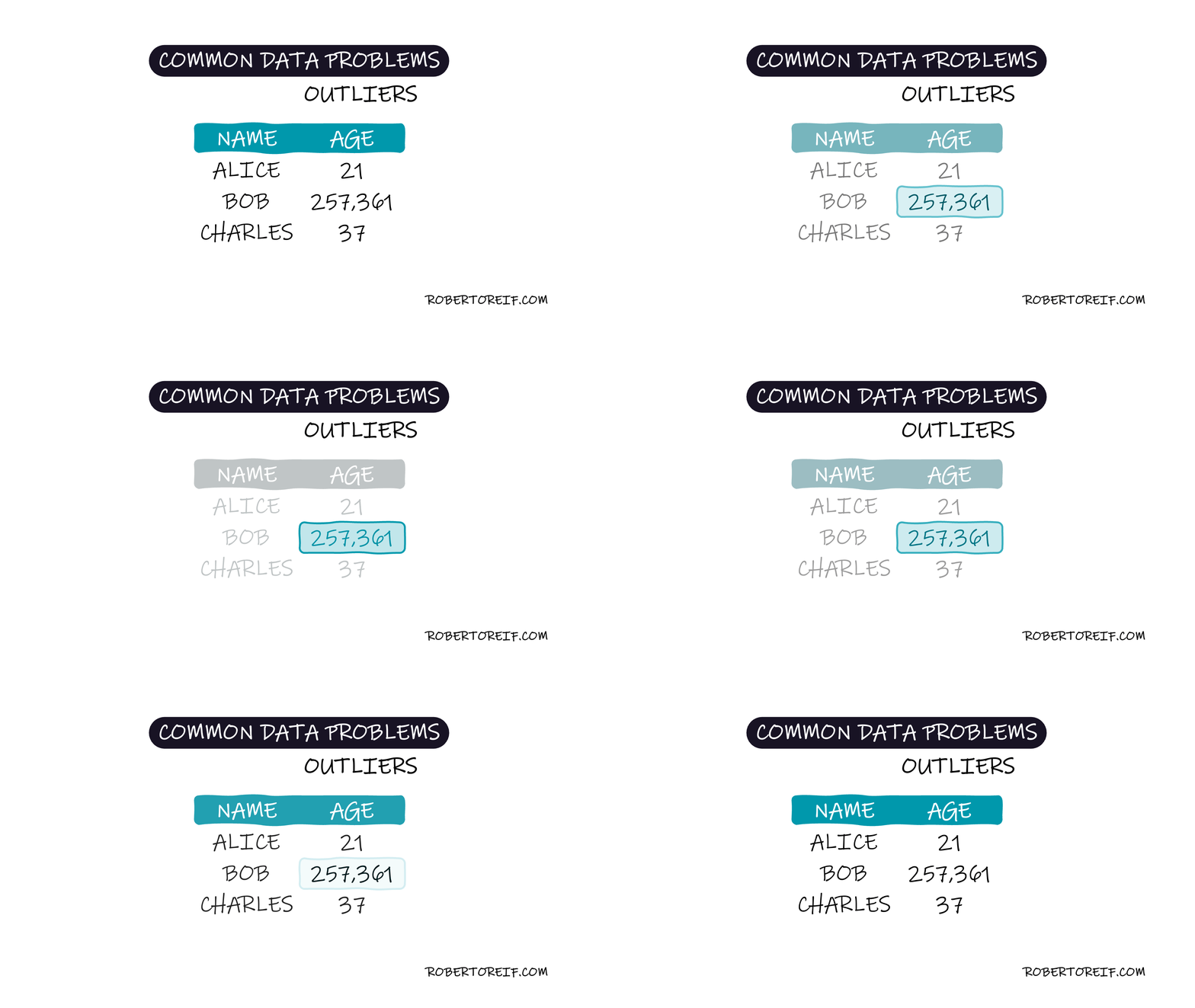
When working with real-world datasets, outliers are a frequent and often tricky issue to manage. Outliers are data points that significantly differ from most observations, either much higher or much lower than expected. If left unaddressed, they can distort statistical analysis and negatively impact machine learning models.
Why Do Outliers Occur?
Outliers can arise for several reasons, including:
Data entry errors (e.g., typing 10,000 instead of 1,000)
Sensor or system malfunctions
Mismatched units or data formats
Natural variability in populations or rare events
Merging datasets with different measurement scales
How to Detect Outliers?
Statistical methods: use the mean and standard deviation, flagging data points that fall beyond a certain threshold (commonly ±3 standard deviations from the mean). Z-scores and modified Z-scores can help identify extreme values.
Interquartile Range (IQR): calculate the IQR and flag values below Q1 - 1.5 × IQR or above Q3 + 1.5 × IQR.
Visualization techniques: box plots and scatter plots are helpful tools for visually spotting outliers. Also, histograms can reveal unusual spikes or long tails in the data distribution.
Domain knowledge: experts may define valid thresholds based on known limits or logical constraints.
How to Handle Outliers?
Remove them: if they are clearly errors or irrelevant, eliminating them may be appropriate.
Cap or floor the values (winsorization): replace outliers with the closest non-extreme values within a chosen percentile range.
Transform the data: applying log, square root, or Box-Cox transformations can reduce the impact of extreme values.
Use robust models: some algorithms (e.g., tree-based models) are more resilient to outliers than others (e.g., linear regression).
Impute values: replace the outlier with a more reasonable estimate such as the median, mean, or a predicted value based on similar data.
Effectively managing outliers is key to improving data quality, ensuring accurate analysis, and enhancing model performance.
How do you handle outliers in your data projects?
Quisque iaculis facilisis lacinia. Mauris euismod pellentesque tellus sit amet mollis.